You draw a horizontal line on your chart, convince yoursel fit is important, and then watch price slam straight through it an hour later.The embarrassing part is not the loss - it is that the line was never really there. You wanted it to be.
Staring at a chart long enough will make you see structure that is not there. That is a psychological fact, not a skill problem. The fixis not to draw better lines; it is to stop drawing lines at all. Automated support and resistance takes the drawing out of your hands, so the level you trade is the level the market actually respects. This guide covers how RelicusRoad Pro finds those zones and the four mechanical rules you need totrade them.
Key Findings
- Manual levels are a psychological trap: look at a chart long enough and your brain will invent a level that was never there.
- Road Levels are objective: RelicusRoad Pro calculates them from historical order blocks and heavy volume clusters, so the boundary is mapped, not imagined.
- Trend bias comes first: in an uptrend you buy only at support; in a downtrend you short only at resistance. One rule removes most false-breakout traps.
- The bounce, not the touch, is the entry: you wait for a rejection candle or a volume spike that proves the level is being defended.
- Stops and targets are mechanical: stop behind the level, target the next level - both are known before you enter.
How automated levels are found
Institutions leave footprints. Where millions of dollars in buy and sell orders sit waiting, price reacts. The problem is you cannot see those order clusters with the naked eye, and by the time you think you can, your bias is already writing the story for you.
- Algorithmic calculation: The software continuously tracks historical order blocks and heavy volume clusters to find the zones that matter.
- Dynamic visual levels: It plots horizontal lines - Road Levels - directly on your charts the moment they are validated.
- Zero subjectivity: You never guess where a zone begins or ends. The boundary iscalculated, so the only debate left is the one you have with your own discipline.
Rule 1: Establish the trend bias first
Never trade a level just because price is approaching it. A level in the middle of a counter-trend is not an opportunity; it is a request to get run over.
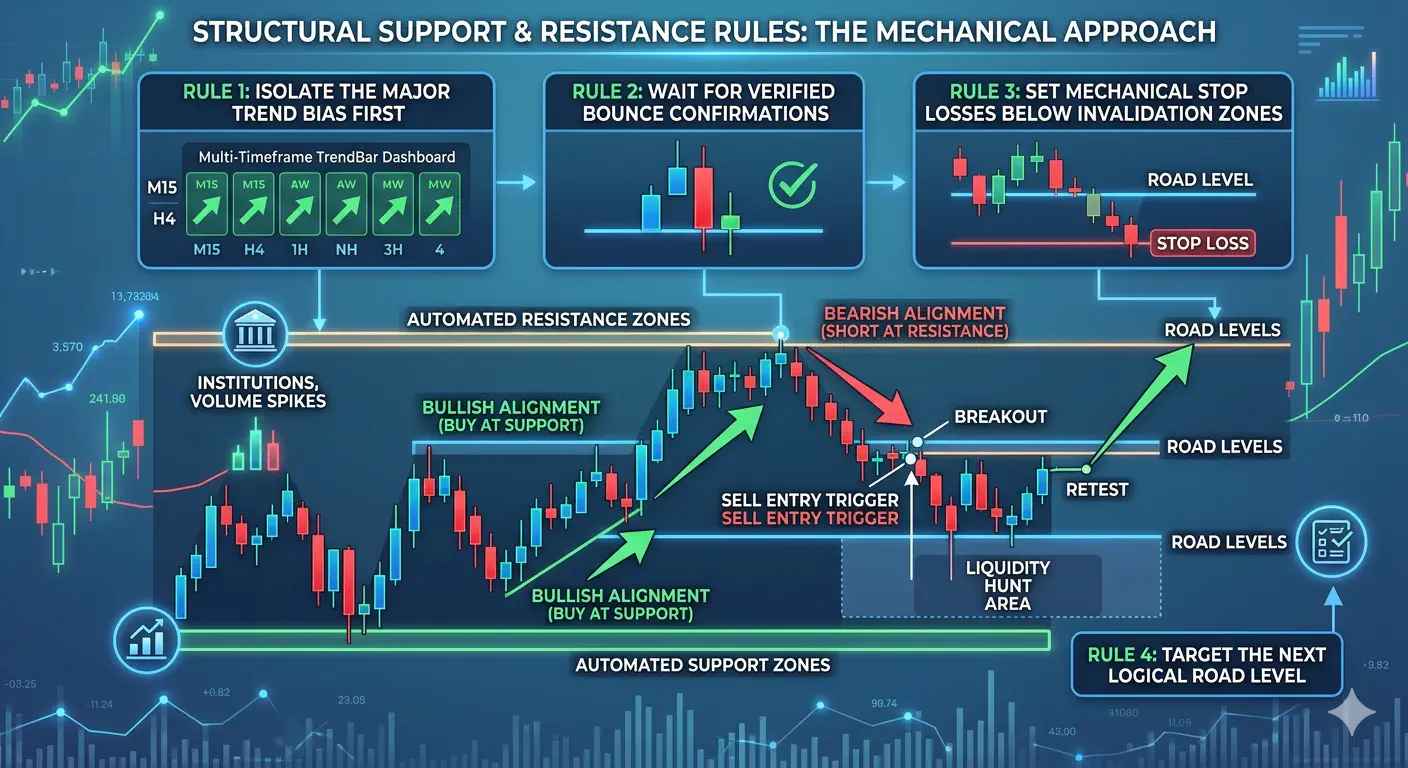
- Trend alignment: Check the Multi-TF TrendBar dashboard to see the macro bias before you even start looking for an entry.
- Directional filter: If the higher timeframes are bullish, you only buy at support. If they are bearish, you only short at resistance.
- Eliminate counter-trend risk: This one rule filters out more than half of all false-breakout traps, and it costs nothing to apply.
Rule 2: Wait for a verified bounce
Amateurs place a limit order directly on a line and hope .Professionals wait until the market proves the level is alive.

- Ther ejection sign: Let price touch the automated level. That touch is information; it is not yet an invitation.
- Candle behavior: Look for a long wick or a strong engulfing candle that shows price being sharply rejected from the zone.
- The trigger: Enter only after the rejection candle closes. By then, the institutions that defend the zone have shown their hand.
A level that is touched and defended is a level you can trade. A level that is touched and ignored is a story. Waiting for the close is what separates the two.
Rule 3: Set mechanical stops behind the invalidation zone
Automated levels give you an exact blue print for risk, which is the closest thing to a gift the market offers.
- Structural placement: Put your protective stop slightly behind the automated Road Level. If that level breaks, the idea is wrong.
- Buffer room: Leave a few pips of breathing room for spread and brief liquidity hunts, without turning your stop into a guess.
- Fixedrisk: Because the level is calculated mathematically, your risk is a known number before you press the button. There is nothing left to decide mid-trade.
Rule 4: Target the next logical Road Level
Taking profit should be as mechanical as the entry. A position held in hope is a position that gives back everything.
- Next-zone targeting: When you buy at support, your primary target is the next resistance line above. The distance is already marked on the chart.
- Breakout management: If price reaches the target on extreme volume momentum, close part of the position and trail the rest.
- No greed:Taking profit where opposing institutional orders are waiting to halt price is not leaving money on the table. It is respecting the same footprint that got you in.
Quick test
Name the trend, the level, the bounce, and the next target before you click. If any of the four is missing, you are trading a picture, not a plan.
Where RelicusRoad Pro fits
Every rule here is built on the same idea: make the chart tell the truth and let the trader supply the discipline. That is what RelicusRoad Pro does. The levels are calculated from real order flow, plotted automatically, and left exactly where the market printed them. You do not have to be a better artist to trade them - you have to be a better rule-follower.
Automated support and resistance will not make every entry a winner. It will make every entry an honest one, and honest entries are repeatable, and repeatable is where the edge lives.
Frequently asked questions
What exactly is a Road Level?
A Road Level is a support or resistance line that RelicusRoad Pro calculates automatically from historical order blocks and volume clusters, then plots on your chart. You do not draw it; you read it.
Do automated levels repaint?
No. They are derived from order blocks and volume data that have already printed, so the line stays where it was when you first saw it. If a level kept moving after the fact, it would be useless for planning a stop.
What if price touches a level but shows no rejection?
Then you do not trade. No rejection candle, no entry. The level was tested and ignored, which is itself useful information - it tells you the zone is weaker than you hoped.
Can I trade counter-trend at a strong level?
You can, and occasionally you will be right. The rules exist because being right occasionally is not a system. If you must take acounter-trend level, at least halve your size and know that you are fighting the bias instead of trading with it.
How many pips of buffer should my stop have?
Just enough to survive spread and a normal liquidity hunt -a few pips on most pairs - but not so much that the trade is no longer tied to the level. If the stop is so far away that the risk stops making sense, the level is not the reason you should be in.
Levels are not the point. Structure is the point, and the point of automation is to remove the parts of structure you are bad at -drawing lines and staying honest. Mark the trend, wait for the bounce, stop behind the level, target the next one. Do that a few times a day and you are no longer guessing.
Ready to see these automated zones on your chart? Checkout Strategy #3 in the RelicusRoad Pro Discord Channel
Keep going on this topic
Support and Resistance Mastery: Zones, Breaks and Retests
Master support and resistance zones with repeatable drawing rules, breakout and retest confirmation, invalidation, position sizing and common mistakes.
- 5 Ways to Use Real-Time Scalp Pivots for Quick Forex Profits
- Pivot Points: The Invisible Map of the Day
- Daily High/Low: The 'Kill Zone' Where Trends Go to Die
- Scalp Pivots Strategy: How to Catch 'Micro-Trends' for Quick Profit
- Murrey Math Lines: Do the 8/8 Levels Actually Hold?
- Trading Liquidity Zones: Where Institutions Actually Fill Their Orders
- The Quasimodo Pattern: The Hunchback that Prints Money
- Wyckoff Explained: How to Spot the Accumulation Phase
- Harmonic Patterns Guide: The Geometry of Markets
- Fibonacci Extensions: Where to Take Profit
- Fibonacci Retracement: How to Draw and Trade the Key Levels
- The Engulfing Candle: The Only Reversal Signal You Need
- The Inside Bar: Coiled Spring Strategy
- Forex Candlestick Patterns: Read the Sequence, Not One Bar
- The Fakeout: Why Breakout Trading is Dead (and what to do instead)
- Break and Retest Strategy: Wait for the Level to Flip
Related reading: Road Levels.