How much should you risk on each trade? This guide answers that for traders who already have a tested system. First, it shows what the Kelly criterion works out. Next, it shows how to turn that into a lot size. Last, it shows why most traders should use only a small part of it.
Here is the short answer. Say you win 60% of your trades. Say your wins are the same size as your losses. Then the Kelly criterion says risk 20% of your account on each trade. Risking the whole Kelly number is called full Kelly. It is the most the math allows. On paper, it grows the account fastest. In real life, it is far too much for almost anyone. The rest of this page shows why, with every number worked out.
Key Findings
- Kelly needs two inputs: how often you win, and how big your average win is next to your average loss.
- Full Kelly is the most the math allows: in the worked example it means risking 25% of the account, or 10 standard lots on $10,000.
- Small mistakes in your inputs cost a lot: in the worked example, if the real win rate is 10 points lower than you measured, full Kelly sizing shrinks the account.
- Use a part, then a cap: half or quarter Kelly at most, and never above your own risk limit or a prop firm's loss limit.
What the Kelly Criterion Answers
The Kelly criterion tells you what share of your account to risk on each trade. That is the size that grows the account fastest over many trades.
Think of your account as a pie. On each trade, you put one slice at risk. Kelly tells you how big that slice should be.
Here is the problem it solves. Say your system has an edge. An edge means it makes money on average. If you risk too little, the account grows slowly. If you risk too much, the losses hurt more than the wins help. Why? A 50% loss needs a 100% gain just to get back to even. So somewhere between “too little” and “too much” is the best size for the long run. Kelly finds that size.
Who should use it:
- Traders with a rule-based system and a record of at least 100 closed trades.
- Traders who want an upper limit on risk per trade, backed by math.
Who should not use it yet:
- Traders without a trade record. Kelly needs real numbers. Guesses give wrong answers.
- Anyone looking for a reason to trade bigger. As you will see, Kelly is a ceiling, not a target.
The Formula, Term by Term
In trading, the Kelly formula is:
K = W − (1 − W) / R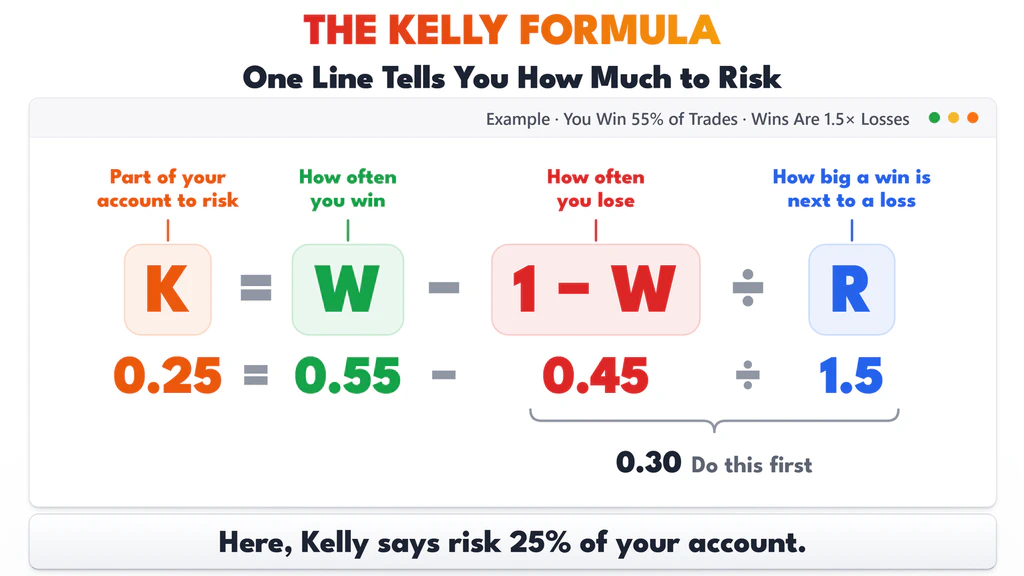
K is the slice of your account to risk on each trade. 1 − W is how often you lose. You only need to measure two things:
| Term | What it means | How to measure it |
|---|---|---|
| W | Win rate: how often you win, written as a decimal | Winning trades ÷ all closed trades |
| R | Payoff ratio: how big your average win is next to your average loss | Average winning trade ÷ average losing trade, in money or pips |
- What it means
- Win rate: how often you win, written as a decimal
- How to measure it
- Winning trades ÷ all closed trades
- What it means
- Payoff ratio: how big your average win is next to your average loss
- How to measure it
- Average winning trade ÷ average losing trade, in money or pips
A tiny example. Take the system from the start of this page: 60% wins, with wins and losses the same size.
- W = 0.60, so 1 − W = 0.40
- R = 1
- K = 0.60 − 0.40 / 1 = 0.60 − 0.40 = 0.20
So full Kelly says risk 20% of the account on each trade. “Risk” here means the money you lose if the stop is hit. It is not the size of the position.
Worked Example: From Win Rate to Lot Size on $10,000
Kelly gives you a percentage. To trade it, you turn that percentage into dollars. Then you turn the dollars into lots. Here is every step for one made-up system.
The inputs. Say your trade record shows:
- Win rate W = 55% (0.55)
- Average win is 1.5 times your average loss, so R = 1.5
- Account balance: $10,000
- Pair: EURUSD, where one standard lot is worth about $10 per pip on a US-dollar account
- Stop: 25 pips from entry (so the target is 25 × 1.5 = 37.5 pips)
Step 1: Work out K.
- 1 − W = 0.45
- (1 − W) / R = 0.45 / 1.5 = 0.30
- K = 0.55 − 0.30 = 0.25, or 25%
Step 2: Turn K into dollars at risk. Multiply the balance by the part of Kelly you choose.
Step 3: Turn dollars into lots. Use the position sizing formula: lots = dollars at risk ÷ (stop in pips × pip value per lot). Here the stop costs 25 × $10 = $250 for each standard lot.
| Sizing | Share of account | Dollars at risk | Lot size | Win if target hit |
|---|---|---|---|---|
| Full Kelly | 25% | $2,500 | 10 lots | $3,750 |
| Half Kelly | 12.5% | $1,250 | 5 lots | $1,875 |
| Quarter Kelly | 6.25% | $625 | 2.5 lots | $937.50 |
| Fixed 1% | 1% | $100 | 0.4 lots | $150 |
- Share of account
- 25%
- Dollars at risk
- $2,500
- Lot size
- 10 lots
- Win if target hit
- $3,750
- Share of account
- 12.5%
- Dollars at risk
- $1,250
- Lot size
- 5 lots
- Win if target hit
- $1,875
- Share of account
- 6.25%
- Dollars at risk
- $625
- Lot size
- 2.5 lots
- Win if target hit
- $937.50
- Share of account
- 1%
- Dollars at risk
- $100
- Lot size
- 0.4 lots
- Win if target hit
- $150
The entry, stop and target stay in the same place every time. Only the lot size moves, from 10 lots down to 0.4.
Look at the first row of the table. Full Kelly says trade 10 standard lots on a $10,000 account. So one stop-out costs a quarter of the balance. For these inputs, the math is right. The next section explains why you still should not trade it.
Why Full Kelly Is Too Aggressive
Full Kelly has two problems. First, the swings are huge. A swing is how far the account moves up or down on one trade. Second, it trusts your inputs to be exact. Either problem is enough to rule it out for most traders.
Problem 1: The Drawdowns Are Huge
A drawdown is how far the account falls from its highest point. At 25% risk per trade, losing streaks cut deep:
| Losses in a row | Balance left | Drawdown |
|---|---|---|
| 1 | 75.00% | 25.00% |
| 2 | 56.25% | 43.75% |
| 3 | 42.19% | 57.81% |
| 4 | 31.64% | 68.36% |
- Balance left
- 75.00%
- Drawdown
- 25.00%
- Balance left
- 56.25%
- Drawdown
- 43.75%
- Balance left
- 42.19%
- Drawdown
- 57.81%
- Balance left
- 31.64%
- Drawdown
- 68.36%
Each loss at full Kelly takes a quarter of what is left. Picture eating a quarter of a pie, then a quarter of what remains, again and again. At 1% risk, the same four losses barely touch the balance.
The risk of ruin guide shows how fast deep drawdowns become likely as risk per trade goes up.
Problem 2: Your Win Rate Is Only a Guess
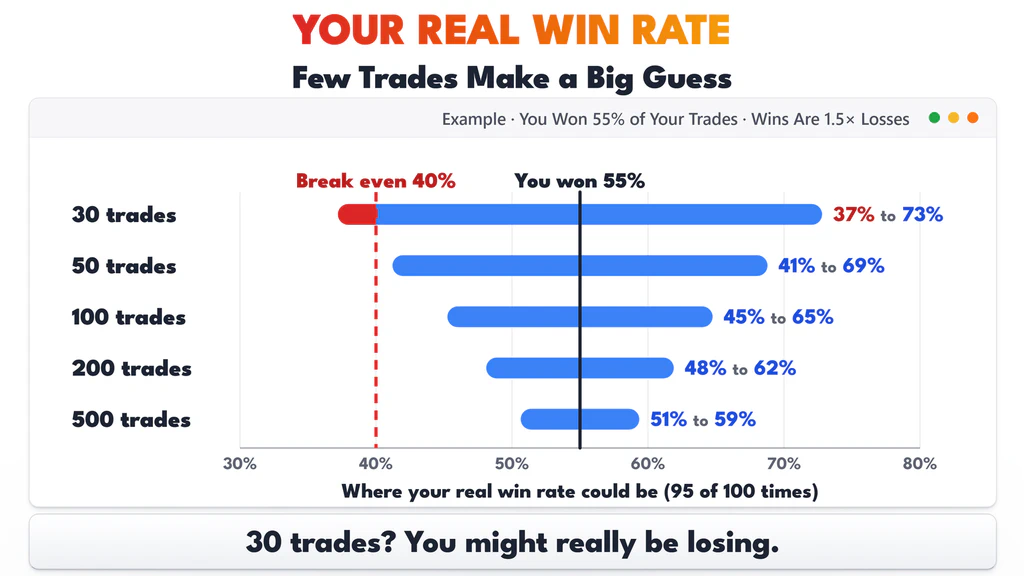
You measured your win rate from a limited number of trades. So the real win rate could be higher or lower. Kelly reacts strongly to even small changes in it. Say you size at 25%, which is Kelly for a 55% win rate. Now say the real win rate is lower. The table shows what happens. “Growth per trade” means how much the account grows or shrinks on each trade, on average.
| Real win rate | Real Kelly | Your 25% is… | Growth per trade at 25% |
|---|---|---|---|
| 55% | 25.0% | 1.0× Kelly | +4.57% |
| 52% | 20.0% | 1.25× Kelly | +2.75% |
| 50% | 16.7% | 1.5× Kelly | +1.54% |
| 45% | 8.3% | 3× Kelly | −1.49% |
| 40% | 0% | No edge | −4.52% |
- Real Kelly
- 25.0%
- Your 25% is…
- 1.0× Kelly
- Growth per trade at 25%
- +4.57%
- Real Kelly
- 20.0%
- Your 25% is…
- 1.25× Kelly
- Growth per trade at 25%
- +2.75%
- Real Kelly
- 16.7%
- Your 25% is…
- 1.5× Kelly
- Growth per trade at 25%
- +1.54%
- Real Kelly
- 8.3%
- Your 25% is…
- 3× Kelly
- Growth per trade at 25%
- −1.49%
- Real Kelly
- 0%
- Your 25% is…
- No edge
- Growth per trade at 25%
- −4.52%
The 45% row is the big lesson. At a 45% win rate and a payoff of 1.5, the system still makes money on average. Its real Kelly is 8.3%. But at 25% risk per trade, the account tends to shrink. Growth of −1.49% per trade leaves a typical account at about 22% of where it started after 100 trades. Betting too much turns a winning system into a losing one.
Fractional Kelly: What Half and Quarter Really Give Up
Fractional Kelly means you risk only a part of the Kelly number, such as half or a quarter. It cuts the swings much more than it cuts growth.
A simple rule of thumb shows how much growth you keep. Say you bet a part c of Kelly. For half Kelly, c is one half. Your growth is then about c × (2 − c) of the best possible growth. Each swing is c times the size of a full Kelly swing, because the dollars at risk shrink by the same amount.
| Part of Kelly (c) | Share of best growth, c × (2 − c) | Swing size vs full Kelly |
|---|---|---|
| 2× (double Kelly) | 0% | 200% |
| 1.5× | 75% | 150% |
| Full (1×) | 100% | 100% |
| Three quarters (0.75×) | 93.75% | 75% |
| Half (0.5×) | 75% | 50% |
| Quarter (0.25×) | 43.75% | 25% |
| Tenth (0.1×) | 19% | 10% |
- Share of best growth, c × (2 − c)
- 0%
- Swing size vs full Kelly
- 200%
- Share of best growth, c × (2 − c)
- 75%
- Swing size vs full Kelly
- 150%
- Share of best growth, c × (2 − c)
- 100%
- Swing size vs full Kelly
- 100%
- Share of best growth, c × (2 − c)
- 93.75%
- Swing size vs full Kelly
- 75%
- Share of best growth, c × (2 − c)
- 75%
- Swing size vs full Kelly
- 50%
- Share of best growth, c × (2 − c)
- 43.75%
- Swing size vs full Kelly
- 25%
- Share of best growth, c × (2 − c)
- 19%
- Swing size vs full Kelly
- 10%
In the figure, growth falls much more slowly than swing size. Two things stand out:
- Half Kelly keeps about three quarters of the growth with half the swing size. For most people, that is the best deal on the table.
- 1.5× Kelly and half Kelly give about the same growth. But 1.5× has three times the swing size. Betting too much buys you pain, not profit.
The rule of thumb holds up on the worked example. Worked out exactly with a 55% win rate and R = 1.5, half Kelly keeps 75.3% of the growth and quarter Kelly keeps 44.3%.
Fractional Kelly also protects you when your win rate guess is wrong. Say you size at half Kelly for a 55% win rate, which is 12.5%. Now say the real win rate is 50%. Its real Kelly is 16.7%, so you are at 0.75× of it. That is still on the safe side.
When Kelly Says Zero or Negative
A Kelly result of zero or below means the system loses money on average. So the right size is zero. Do not trade it, however good the last few trades felt.
Kelly hits zero at the break-even win rate. That is the win rate where you neither make nor lose money over time. It equals 1 / (1 + R). So the line moves with the payoff:
| Payoff ratio (R) | Break-even win rate |
|---|---|
| 1 | 50.0% |
| 1.5 | 40.0% |
| 2 | 33.3% |
| 3 | 25.0% |
- 1
- 50.0%
- 1.5
- 40.0%
- 2
- 33.3%
- 3
- 25.0%
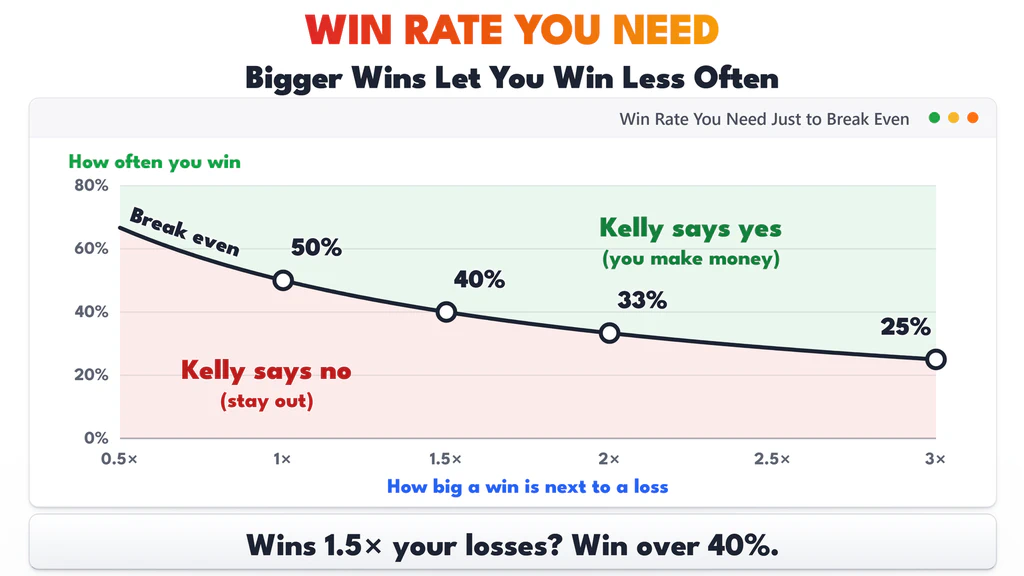
So winning less than half the time is not always bad. Some examples:
- 40% wins at R = 2: K = 0.40 − 0.60 / 2 = +10%. This is positive, even though most trades lose.
- 30% wins at R = 2: K = 0.30 − 0.70 / 2 = −5%. This is negative, so do not trade it.
- 45% wins at R = 1: K = 0.45 − 0.55 / 1 = −10%. This is negative too, so do not trade it.
Win rate and payoff only mean something together. That makes Kelly useful even if you never size by it. It is a quick test: do your numbers show an edge at all? But the test is only as good as your trade record. A short or careless record gives a weak answer. The realistic expectations guide shows what normal win rates and payoffs look like.
Kelly vs Fixed 1% Risk vs Prop Firm Limits
For most retail traders, Kelly is a ceiling, not a target. Your real size should be the smallest of three numbers. One is a part of Kelly. One is your own risk limit. One is any limit your prop firm sets.
| Approach | Risk per trade in the example | Strength | Weakness |
|---|---|---|---|
| Full Kelly | 25% | Fastest growth if the inputs are exact | Huge drawdowns; inputs are never exact |
| Quarter Kelly | 6.25% | Keeps about 44% of growth, much smaller swings | Still large for most accounts |
| Fixed 1% | 1% | Simple, lives through long losing streaks | Grows slower than Kelly allows |
| Prop firm limits | Set by the rules | Keeps you inside the challenge | Ignores your edge completely |
- Risk per trade in the example
- 25%
- Strength
- Fastest growth if the inputs are exact
- Weakness
- Huge drawdowns; inputs are never exact
- Risk per trade in the example
- 6.25%
- Strength
- Keeps about 44% of growth, much smaller swings
- Weakness
- Still large for most accounts
- Risk per trade in the example
- 1%
- Strength
- Simple, lives through long losing streaks
- Weakness
- Grows slower than Kelly allows
- Risk per trade in the example
- Set by the rules
- Strength
- Keeps you inside the challenge
- Weakness
- Ignores your edge completely
Fixed 1% risk. In the worked example, 1% is 0.04 of the Kelly number. By the c × (2 − c) rule, it keeps about 8% of the best growth. That sounds low. But it buys a lot of safety. And the account still snowballs: each gain is added to the balance, so the next 1% is a little bigger. The position sizing guide covers fixed-percentage sizing in more depth.
Prop firm challenges. Say your firm has a 5% daily loss limit. At quarter Kelly (6.25%), one loss breaks it. At 1% of a $10,000 balance, you risk $100 per trade. Then it takes five losses in a row in one day to reach $500, the 5% limit. In a challenge, the firm’s rules set your size. The prop firm rules guide explains how daily and maximum drawdown limits work.
Where Kelly still helps:
- It tells you whether your system has an edge (K above zero).
- It tells you the most you should ever risk. If Kelly with honest inputs says 4%, risking 5% makes no sense.
- It shows which systems deserve more money, since a higher K means a stronger edge.
Checklist: Measuring Your Inputs
Kelly is only as good as W and R. So measure them with care. Work through these steps before you trust the number.
1. Use enough trades. A win rate from only a few trades is a rough guess. Think of a bag of marbles. Pull out a few, and you can only guess how many are red. Pull out many, and your guess gets much closer. The table shows the likely range for a measured 55% win rate. Each range holds the real win rate 95 times out of 100.
| Closed trades | Likely range of real win rate | Kelly at the low end (R = 1.5) |
|---|---|---|
| 30 | 37.2% to 72.8% | Negative |
| 50 | 41.2% to 68.8% | 2.0% |
| 100 | 45.2% to 64.8% | 8.7% |
| 200 | 48.1% to 61.9% | 13.5% |
| 500 | 50.6% to 59.4% | 17.7% |
- Likely range of real win rate
- 37.2% to 72.8%
- Kelly at the low end (R = 1.5)
- Negative
- Likely range of real win rate
- 41.2% to 68.8%
- Kelly at the low end (R = 1.5)
- 2.0%
- Likely range of real win rate
- 45.2% to 64.8%
- Kelly at the low end (R = 1.5)
- 8.7%
- Likely range of real win rate
- 48.1% to 61.9%
- Kelly at the low end (R = 1.5)
- 13.5%
- Likely range of real win rate
- 50.6% to 59.4%
- Kelly at the low end (R = 1.5)
- 17.7%
2. Use closed trades from one rule set. Count only trades that are fully closed. They should all follow the same rules. If you changed how you set stops halfway through, the two halves are different systems. A trading journal makes this easy to sort.
3. Include costs. Spread, commission and slippage make every win smaller and every loss bigger. Slippage is when your order fills at a worse price than you asked for. In the worked example, a 37.5-pip win and a 25-pip loss give R = 1.5. Now add 1.5 pips of cost per trade. The win becomes 36 pips and the loss becomes 26.5 pips. R falls to 1.36, and Kelly drops from 25% to 21.9%.
4. Prefer live or forward results. Backtests test your rules on old charts. They tend to look better than live trading. If you only have backtest numbers, treat them as the best case and size down more.
5. Recheck often. Markets change. Work out W and R again every 50 to 100 new trades. If K falls, cut your size.
6. Apply the caps. Take half or a quarter of your honest K. Then cap it at your own limit and any prop firm limit. The smallest number wins.
Summary
- A Kelly result at or below zero means there is no edge. So do not trade the system.
- Use Kelly as a ceiling. Your real size is the smallest of three numbers: your part of Kelly, your own risk limit and your prop firm’s limit.
Keep going on this topic
Position Sizing: The Boring Math That Keeps Traders Alive
A plain-English guide to position sizing forex with worked examples: turn a fixed percentage of risk into a lot size on any pair, and keep your losses uniform.
- Risk Reward Ratio: Why 1:3 Alone Won't Save You
- Monte Carlo simulation trading: what backtests hide
- ATR Indicator Guide: How to Size Stops to Real Volatility
- Correlation Diversification: Don't Put All Your Eggs in the USD Basket
- Currency Correlations: The Hidden Risk in Your Portfolio
- Forex Currency Correlation: Measure Hidden Exposure
- Trading Multiple Forex Pairs Without Duplicating Risk
- Knowing When to Fold: The Art of the Profit Target
- The Perfect Hedge: How to Lock in Profit Without Closing
- Most Volatile Forex Pairs: How to Measure and Trade Risk
- Risk Management with Advanced Indicators: Beyond the Stop Loss
- Realistic Expectations in Trading: The Math of Consistency
- Trading Tools That Build Patience, Not Blow Accounts
- Chande Kroll Stop Indicator: Read Both Stop Lines
- EUR/JPY Price Forecast: How to Trade the 184.00 Zone
- Forex order types explained: what each one costs you at the fill