A strong up candle prints. Then three red candles follow it, and every one of them looks like the start of a turn. Most traders either sell too early or freeze.
The rising three methods pattern is the name for the case where that fear was wrong. It is a five-candle pattern in which an up-trend rests for three small candles without giving back the first candle’s gains, then moves on. By the end of this guide you will know how to tell that rest from a real turn, and where the entry and stop go when it is real.
Key Findings
- Five candles, strict rules: a long up candle, three small candles inside its high-to-low range, then a long up candle that closes above the first candle's close.
- Continuation only: the pattern needs an up-trend already in place, because it describes buyers resting, not buyers arriving.
- The pause decides it: one close below candle 1's low cancels the pattern, whatever the fifth candle does next.
- Risk is set by the pause: buy the close of candle 5, stop under the lowest point of the pause, and size from that distance.
What is the rising three methods pattern?
Rising three methods is a bullish continuation pattern made of five candles. A long up candle sets a range, three small candles drift down inside that range, and a fifth long up candle closes above the first one’s close. Steve Nison brought it to Western traders in Japanese Candlestick Charting Techniques (1991) as one of the “methods” patterns, which describe a trend taking a rest.
Watch the shaded box in the clip. Nothing in the pause closes outside candle 1’s range, and that is what separates a rest from a sell-off.
The three small candles are usually red, but colour matters less than size and position. They should be clearly smaller than candle 1, and their bodies should sit inside its high and low. Stricter texts want exactly three. Some charting scanners accept two or four, which is one reason the name gets stuck on shapes that do not deserve it.
Is it a pause or the start of a turn?
It is a pause only if all three checks pass: the trend was already up, the small candles stay inside candle 1, and candle 5 closes above candle 1’s close. Fail any one and you are looking at a different, weaker picture, so there is no trade.
- Look left of candle 1 for higher highs and higher lows.
- Check that no small candle closes below candle 1’s low.
- Wait for candle 5 to close above candle 1’s close.
The order matters. Check the trend first, before you ever look at the five candles, because the same shape after a long fall has nothing to continue.
Candle 5 closing above candle 1’s close is the last check, and it is the one people skip. A long green candle that stops short of that close is still inside the pause. Wait for the close; a wick poking above does not count.
How strict should the rules be?
Strict enough that you rarely see the pattern. Thomas Bulkowski, whose pattern site grew out of his Encyclopedia of Candlestick Charts (Wiley, 2008), treats it as one of the less common candle formations. If your chart shows one every week, the rules are being bent.
| Feature | Strict rising three methods | Loose version (skip it) |
|---|---|---|
| Trend before candle 1 | Clear higher highs and higher lows | Flat, choppy, or falling |
| Candle 1 | Long up body, small wicks | Average-sized candle |
| The pause | Three small candles inside candle 1’s range | One candle closes below candle 1’s low |
| Candle 5 | Long up candle, closes above candle 1’s close | Closes inside the pause, or only its wick breaks out |
| What it tells you | Buyers rested and kept control | Nothing you can size a trade from |
- Strict rising three methods
- Clear higher highs and higher lows
- Loose version (skip it)
- Flat, choppy, or falling
- Strict rising three methods
- Long up body, small wicks
- Loose version (skip it)
- Average-sized candle
- Strict rising three methods
- Three small candles inside candle 1’s range
- Loose version (skip it)
- One candle closes below candle 1’s low
- Strict rising three methods
- Long up candle, closes above candle 1’s close
- Loose version (skip it)
- Closes inside the pause, or only its wick breaks out
- Strict rising three methods
- Buyers rested and kept control
- Loose version (skip it)
- Nothing you can size a trade from
The table is the filter. Every row on the right has a cost: a flat trend has nothing to continue, and a close below candle 1’s low means sellers already won a round.
Forex adds one wrinkle. Nison’s rules came from exchange markets, where candles often gap at the open. Currency pairs trade around the clock, so a new daily candle usually opens where the last one closed. The daily close itself depends on your broker’s server clock; many set it so the day ends at 5 p.m. New York time. Two brokers on different clocks can draw different daily candles, so one shows the pattern and the other does not.
Where do entry, stop and target go?
Buy at the close of candle 5, put the stop under the lowest low of the pause, and set the target at twice the risk. That 2R target means the distance to the target is two times the distance to the stop, so one win covers two losses.
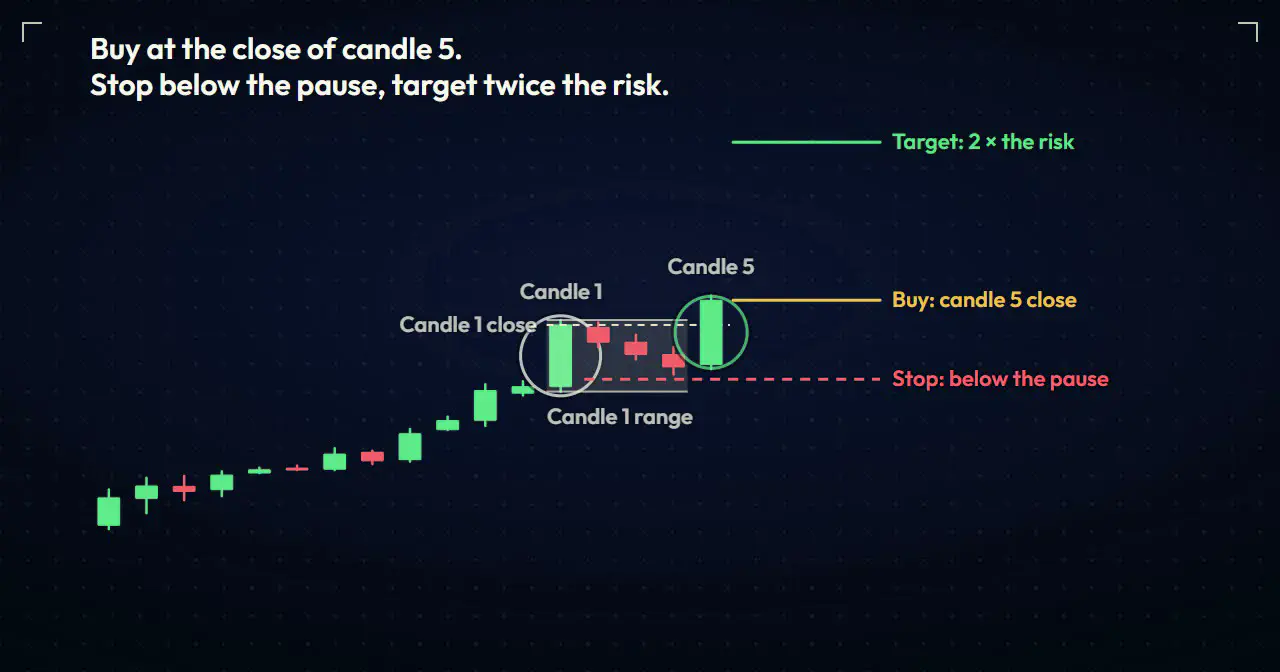
A tighter stop under the pause works when the three small candles are calm. When they swing wide, move the stop below candle 1’s low instead and accept a smaller position. The risk-reward ratio guide covers why the stop comes before the target, never after.
How does it compare with similar patterns?
Rising three methods is the strictest of the trend-rest shapes, and the rarest. The others describe a related idea with looser rules or a different message.
| Pattern | Trend needed | Candles | What it says |
|---|---|---|---|
| Rising three methods | Up-trend | Five | Buyers rested inside one candle, then pushed on |
| Falling three methods | Down-trend | Five | Sellers rested inside one candle, then pushed on |
| Bull flag | Up-trend | Many | A longer rest that slopes against the trend |
| Three white soldiers | Decline or drift | Three | Control changing hands, not a rest |
- Trend needed
- Up-trend
- Candles
- Five
- What it says
- Buyers rested inside one candle, then pushed on
- Trend needed
- Down-trend
- Candles
- Five
- What it says
- Sellers rested inside one candle, then pushed on
- Trend needed
- Up-trend
- Candles
- Many
- What it says
- A longer rest that slopes against the trend
- Trend needed
- Decline or drift
- Candles
- Three
- What it says
- Control changing hands, not a rest
If you like the idea but find the candle version too rare, the flag and pennant guide covers the looser chart-pattern cousin. And if three long green candles are what caught your eye, that is a different message entirely; the three white soldiers pattern is about a turn, not a rest.
Where does RelicusRoad Pro fit?
The pattern tells you buyers rested. It does not tell you whether they rested at a level that matters. A five-candle pause that holds right on top of a known support zone is a stronger read than the same pause in open space.
RelicusRoad Pro draws those zones once and leaves them where they were drawn, so the level under your pause today is the same level you see when you review the trade next week. It will not spot the pattern for you, and it will not tell you the trend will continue. It gives the pause something fixed to stand on.
Frequently asked questions
What is the rising three methods pattern? A five-candle continuation pattern inside an up-trend. A long up candle comes first, then three small candles that stay inside its high-to-low range, then a long up candle that closes above the first candle’s close. It says buyers paused without losing control, then pushed on.
Is rising three methods bullish or bearish? Bullish, as a continuation rather than a reversal. It needs an existing up-trend. The same five candles after a long decline have no trend to continue. Its bearish mirror is the falling three methods.
What is the difference between rising three methods and falling three methods? Direction only. Falling three methods is a long down candle, three small candles inside its range, then a long down candle closing below the first candle’s close, inside a down-trend. Both use the same three checks.
Where should the stop go on a rising three methods trade? Below the lowest low of the three small candles is the tight choice. Below candle 1’s low is the wider one. Pick the stop that sits outside normal noise, then size the position so that distance is one normal unit of risk.
How is rising three methods different from a bull flag? Same idea, different scale. A bull flag can run for many candles and slope against the trend. Rising three methods has exact rules. It needs five candles, with the pause held inside one candle’s range. The flag is more common; the candle pattern is stricter.
Run the three checks on the next pause you see in an up-trend, and only then plan the buy. To keep the support zones under that pause fixed while you do, start with RelicusRoad Pro.
Written for RelicusRoad by RelicusDigital.com.
Keep going on this topic
Support and Resistance Mastery: Zones, Breaks and Retests
Master support and resistance zones with repeatable drawing rules, breakout and retest confirmation, invalidation, position sizing and common mistakes.
- Marubozu candlestick: when a no-wick candle means it
- Dark cloud cover pattern: the depth test most traders skip
- Rounding Bottom Pattern: How to Trade a Base, Not a Bounce
- Shooting star candlestick pattern: one rejected high is not a top
- Spinning top candlestick pattern: the indecision candle
- Three white soldiers pattern: real reversal or exhausted run?
- Triangle chart pattern: trade the flat side, not the shape
- Triple Top and Triple Bottom Pattern: Trade the Third Test
- Tweezer top and bottom pattern: the level matters more than the candles
- VWAP: The Institutional Price Tag
- Wolfe Wave Pattern: Entry at Point 5, Target on Line 1-4
- Supply and Demand Zones: The Only Support & Resistance That Matters
- Candlestick patterns cheat sheet: bullish, bearish, neutral
- Bullish candlestick patterns: 9 that matter, ranked
- Supply and Demand Indicators: How to Read Zones Without Guessing
- Order Blocks vs. Supply Zones: Is there a Difference?