You spend a weekend watching smart-money videos and come away more confused than when you started. Order blocks, BOS, CHoCH, mitigation, inducement, fair value gaps, the acronyms pile up until a simple chart feels like a foreign language. The frustrating part is that the core ideas underneath all that jargon are genuinely useful and genuinely simple.
By the end of this you will be able to read the three building blocks that everything else in smart money concepts rests on, mark them on a chart yourself, and tell the difference between an honest tool and one that is flattering you with hindsight.
Key Findings
- SMC is three ideas, not thirty: market structure, order blocks, and liquidity carry almost all the weight.
- Structure is just swing highs and lows: a break in that sequence is the first honest sign control may be shifting.
- Order blocks are zones to watch, not promises: they mark where large orders likely sat before an impulsive move.
- The marks must lock at candle close: a tool that redraws its structure in hindsight describes the past, not the next trade.
What are smart money concepts in trading?
Smart money concepts, usually shortened to SMC, is a way of reading charts that centers on where large institutional orders are likely being filled. The “smart money” is the banks, funds, and large desks whose order flow moves price more than the retail crowd does. The premise: if you can spot where those big orders sit, you can trade with that flow instead of getting run over by it.
Strip away the jargon and SMC rests on three building blocks. Market structure is the skeleton, the sequence of highs and lows that tells you the trend. Order blocks are the areas where large orders appear to have been absorbed. Liquidity is the fuel, the pool of resting orders that big players need to fill into. Almost every fancier term you will hear is a variation on one of these three.
The scale behind the idea is real. The Bank for International Settlements, in its 2022 Triennial Central Bank Survey, put average daily foreign-exchange turnover at roughly 7.5 trillion US dollars. Orders that size cannot be filled on a quiet tick. They get worked into pools of existing liquidity, and that mechanical reality is what gives structure to the moves SMC tries to read.
What is market structure and a break of structure?
Market structure is the simplest of the three, and the one to learn first. In an uptrend, price makes higher highs and higher lows. In a downtrend, lower highs and lower lows. That sequence is the structure. Reading it is mostly a matter of marking swing points honestly and watching whether the pattern holds.
Two events matter. A break of structure, or BOS, is when price closes beyond the most recent swing in the direction of the trend, confirming the trend is still going. A change of character, or CHoCH, is when price breaks structure against the trend, the first hint that control may be changing hands. The distinction sounds technical but it is plain in practice: BOS says “more of the same,” CHoCH says “something just shifted, pay attention.” Mislabelling the second one is where beginners lose money, so it is worth reading how to tell the two breaks apart candle by candle before you trade either.
One discipline separates traders who use structure well from those who fool themselves: read it from the candle close, not the wick. A spike that pokes past a swing and pulls back has not broken anything. A close beyond it has. Most “failed” structure calls are really intrabar noise mistaken for a break.
What is an order block and how do you spot one?
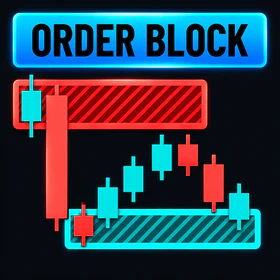
An order block is the last opposite-colored candle before a strong, impulsive move away from an area. Before price ran higher, there was usually a final down candle where large buy orders were absorbed. That candle’s range becomes the order block, a zone you watch in case price returns to it.
Why would price come back? Large positions are rarely filled in one shot. A desk may leave resting orders in that area to add to its position, so a revisit can draw a reaction. That is the logic. The honest caveat is that it is a tendency, not a rule. An order block is an area of interest, somewhere to wait for confirmation, never a line price is obligated to respect. Treating every order block as a guaranteed bounce is how beginners donate stops to the market.
If the idea of “an area where a strong move began” sounds familiar, it should. It overlaps heavily with classic supply and demand. The supply and demand zones guide and the order block versus supply zone breakdown walk through where these ideas agree and where they differ.
How does SMC compare to traditional technical analysis?
A fair question, because much of SMC is rebranded classic analysis with new labels. Here is the honest mapping.
| Smart money term | Traditional equivalent | What it actually marks |
|---|---|---|
| Market structure / BOS / CHoCH | Trend, higher highs and lows, trend reversal | The sequence of swings and where it breaks |
| Order block | Supply / demand zone | The base candle before a strong move away |
| Liquidity grab / stop hunt | Stop run, false breakout | A sweep past a level to trigger resting stops |
| Liquidity pool | Cluster of stops at swing highs/lows | Where resting orders sit, just beyond the obvious level |
- Traditional equivalent
- Trend, higher highs and lows, trend reversal
- What it actually marks
- The sequence of swings and where it breaks
- Traditional equivalent
- Supply / demand zone
- What it actually marks
- The base candle before a strong move away
- Traditional equivalent
- Stop run, false breakout
- What it actually marks
- A sweep past a level to trigger resting stops
- Traditional equivalent
- Cluster of stops at swing highs/lows
- What it actually marks
- Where resting orders sit, just beyond the obvious level
The value of the SMC vocabulary is that it keeps your attention on why price moves toward a level rather than just where the level is. The risk is using the jargon as a substitute for thinking. If you already read structure and supply and demand well, you know more SMC than the acronyms suggest.
Why does liquidity tie it all together?
The third block connects the other two. Liquidity is the pool of resting orders, mostly stop-losses, sitting just beyond obvious levels: under swing lows, above swing highs, around round numbers. Large players need that pool to fill into without moving price against themselves, so price is often drawn to a liquidity pool before it reverses. A break of structure that runs straight into a fresh pool is far more meaningful than one in empty space.
This is also where beginners get hurt. You see a clean support level, place a stop just under it, and watch price sweep through, trigger your stop, and reverse without you. That sweep is the liquidity grab, and it is the same event whether you call it SMC or a false breakout. The fuller mechanics, including how to keep your stop out of the obvious pool, are in the trading liquidity zones guide.
How should a beginner start with smart money concepts?
Keep it small and concrete. The acronym pile grows fast, but you only need a short routine to begin.
- Mark structure first. On one pair, on one timeframe, label the recent swing highs and lows. Decide if structure is up, down, or sideways before anything else.
- Find one order block. Locate the last candle before the most recent strong move and shade its range. One per chart is plenty while you learn.
- Note the nearest liquidity. Where are the obvious stops? Just beyond those swings. Expect price to reach for them.
- Wait for confirmation, then manage risk. A return to an order block is a reason to watch, not to fire blindly. Risk a small, fixed fraction of your account and let the close confirm.
An indicator cannot fix poor risk management; it sharpens timing. The same honesty applies to a fancy SMC dashboard. It can save you time labeling structure, but it cannot make a low-probability trade into a good one.
Why repainting ruins any SMC tool
Here is the trap that catches beginners hardest. Plenty of SMC indicators repaint: they redraw structure, order blocks, or liquidity sweeps after the candle closes. On the historical chart it looks immaculate, every BOS and grab marked as if it called them in advance. Live, you act on the version that exists before the candle settles, and that version can shift or vanish.
A mark is only a decision aid if it locks once the candle closes and never moves again. If your tool keeps adjusting its structure to fit what price just did, it is narrating the past, not preparing you for the next move. For the full method of checking this yourself, the non-repaint indicator explainer shows the simple screenshot test that exposes a repainting tool in minutes.
How RelicusRoad Pro handles smart money concepts
RelicusRoad Pro labels market structure, zones, and liquidity from confirmed price action and commits each mark once the candle closes, so the structure you study live is the same structure that stays on the chart afterward. It will not invent a clean break or order block after the move has already happened, which is the whole point of a tool you can actually trade from.
No indicator removes the sweep or the risk. What an honest one does is keep your reading consistent and your hindsight bias in check, across MT4, MT5, and TradingView.
Frequently asked questions
What are smart money concepts in trading? Smart money concepts, or SMC, is a way of reading price charts that focuses on where large institutional orders are likely being filled. It is built from three plain ideas: market structure (the sequence of swing highs and lows), order blocks (areas where big orders appear to have sat before a strong move), and liquidity (pools of resting stop-losses beyond obvious levels). The goal is to trade with the larger flow rather than against it.
Is SMC trading legit or just hype? The underlying mechanics are real. Large players genuinely need pooled liquidity to fill big positions, and that need shapes how price moves around obvious levels. What gets oversold is the certainty. SMC describes tendencies, not guarantees, and a lot of online teaching wraps simple ideas in heavy jargon. Treat it as one lens for reading structure, paired with strict risk management, not a secret code that prints money.
What is a break of structure? A break of structure, or BOS, is when price closes beyond the most recent swing point in the direction of the existing trend, confirming that trend is continuing. A change of character, or CHoCH, is the opposite: price breaks the structure against the prevailing trend, the first hint that control may be shifting. Both are read from candle closes, not intrabar spikes.
What is an order block? An order block is the last opposite-colored candle before a strong, impulsive move away from an area. The thinking is that large orders were absorbed there before price ran, so the zone may attract a reaction if price returns. It is an area of interest to watch for confirmation, not a line that price must respect.
Do I need a special indicator for smart money concepts? No. You can mark structure, order blocks, and liquidity by hand once you understand them. An indicator helps by labeling these areas consistently and saving time, but only if it commits each mark at candle close and never moves it afterward. A repainting tool that redraws its structure in hindsight makes the chart look perfect and teaches you nothing you can act on in real time.
Start with structure, add one order block, respect the liquidity, and refuse any tool that edits its marks after the fact.
See how RelicusRoad Pro marks non-repainting structure and zones across MT4, MT5, and TradingView →
Keep going on this topic
What Is Forex Trading and How Does It Work?
Learn what forex trading is, how currency pairs and prices work, who trades the market, what it costs and why leverage makes retail forex risky.
- How to Trade Forex for Beginners: A Safer Process
- Myfxbook vs FX Blue: A Beginner's Account Analytics Guide
- The Casino in Your Pocket: Are You a Trader or a Gambler?
- Part-Time Forex Trading With a Full-Time Job
- Don't Quit Your Job: The Case for Part-Time Trading
- Forex Demo Account vs Live Account: What Changes?
- Forex Cent Account vs Standard Account: Key Differences
- Forex Lot Size Explained: Standard, Mini, Micro and Nano
- Forex Spread, Commission and Swap: Calculate Your Cost
- The Tax Man Cometh: Trading as a Business vs. Hobby
- The Best & Worst of Mobile Trading
Related reading: Support and Resistance Mastery: Zones, Breaks and Retests.