Swing Trading vs Day Trading: Costs, Risk and Fit
Swing trading vs day trading is not a contest between a calm method and an exciting one. It is a choice between two different operating systems: one concentrates decisions inside the trading day, while the other holds positions across sessions.
The better style is the one whose time demands, costs and risks you can execute consistently. Neither approach creates profitability on its own, and neither removes the need for a tested process and strict position sizing.
When comparing day trading vs swing trading, do not confuse either one with long-term investing. Both are active trading approaches with predefined entry and exit points. Their main difference is the time frame, holding risk and number of decisions required.
What is the difference between swing trading and day trading?
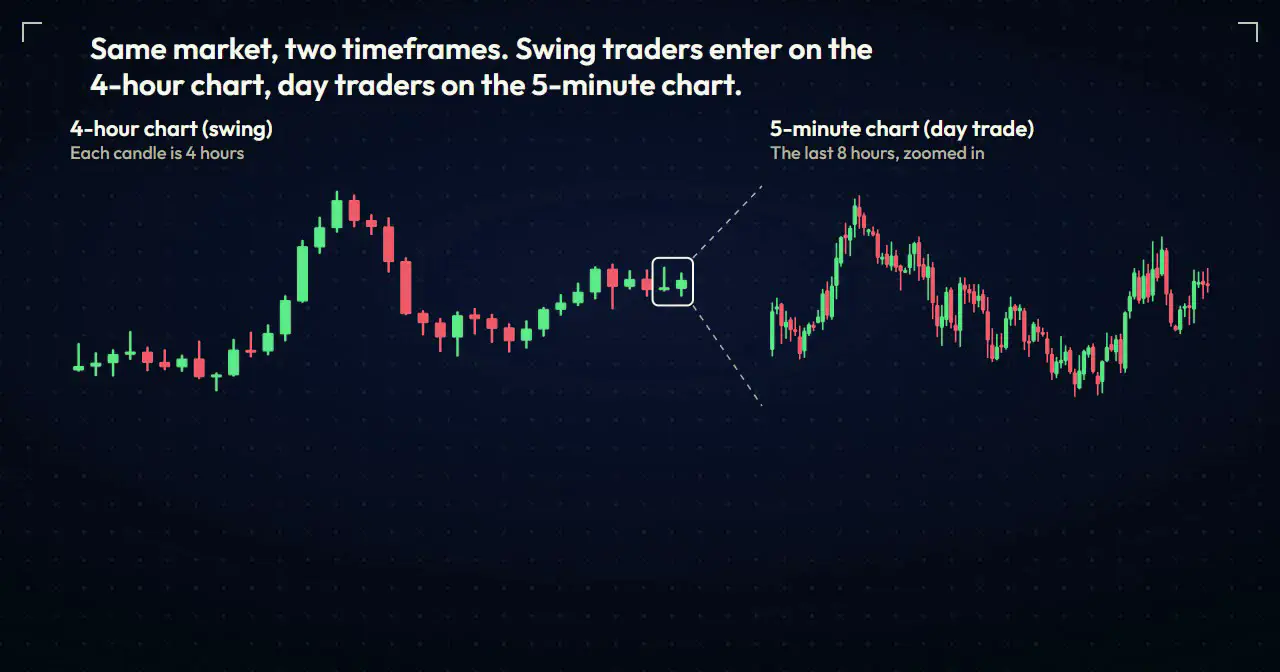
Day traders normally open and close positions within the same trading day. Swing traders hold positions for several sessions, aiming to capture a larger move while accepting overnight exposure. The practical difference is therefore not just timeframe; it is how often you decide, how often you pay transaction costs and which risks remain open.
| Factor | Day trading | Swing trading |
|---|---|---|
| Typical holding period | Minutes to hours | Days to weeks |
| Screen time | Concentrated and usually high | Lower frequency, but alerts still matter |
| Transaction frequency | Usually higher | Usually lower |
| Overnight and weekend risk | Usually avoided | Must be planned for |
| Financing or swap costs | Often limited by same-day exits | Can accumulate across sessions |
| Decision pressure | Fast and repeated | Slower, with more waiting |
| Common failure mode | Overtrading or chasing | Moving stops or ignoring gap risk |
- Day trading
- Minutes to hours
- Swing trading
- Days to weeks
- Day trading
- Concentrated and usually high
- Swing trading
- Lower frequency, but alerts still matter
- Day trading
- Usually higher
- Swing trading
- Usually lower
- Day trading
- Usually avoided
- Swing trading
- Must be planned for
- Day trading
- Often limited by same-day exits
- Swing trading
- Can accumulate across sessions
- Day trading
- Fast and repeated
- Swing trading
- Slower, with more waiting
- Day trading
- Overtrading or chasing
- Swing trading
- Moving stops or ignoring gap risk
This table describes the workload, not the expected return. A slower chart can still produce poor decisions, and a fast chart can still be traded methodically.
How do the entry and exit processes differ?
Day traders focus on short-term price movements and usually close open positions before the session ends. Their trading opportunities may come from intraday breakouts, pullbacks or range behavior. Because the decision window is short, the stop-loss rule, maximum trades per day and session cutoff must be explicit before trading begins.
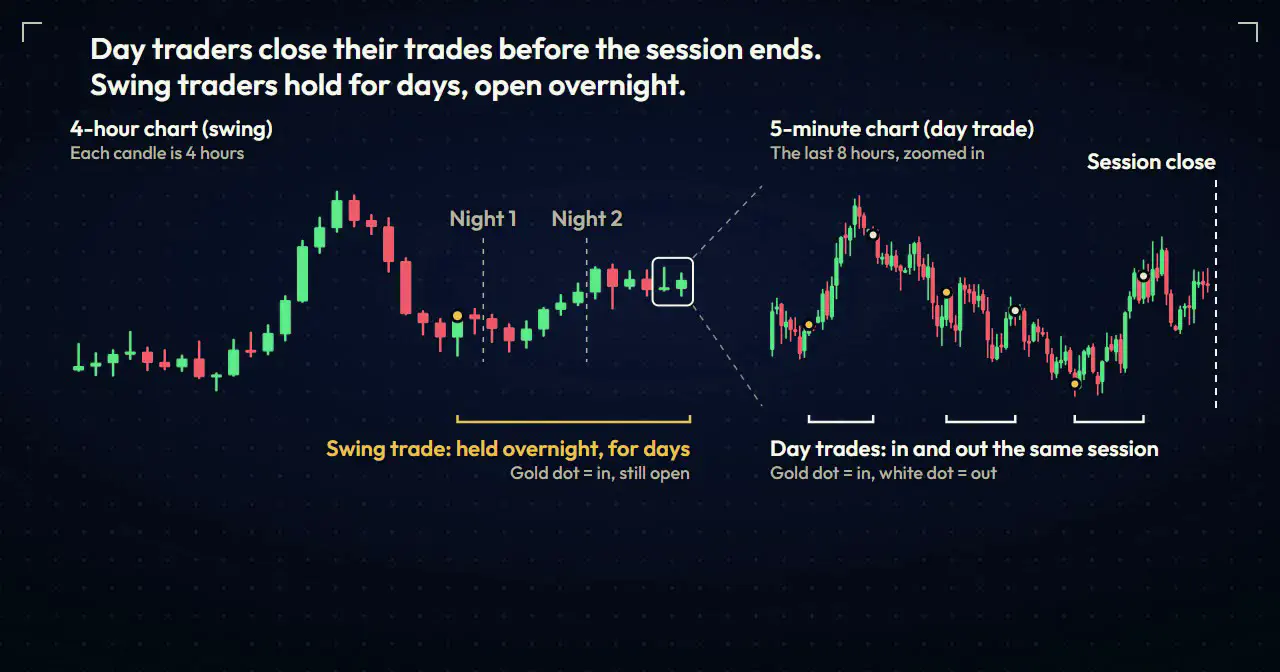
Swing traders may hold positions for days or weeks while seeking larger price swings. Swing trading strategies often use a higher time frame for direction and a lower one for execution. Some rely heavily on technical analysis such as price action, moving averages or market structure to frame those market swings, but those tools do not remove overnight gaps or financing costs.
Neither process requires a prediction of every market move. The trader needs a repeatable setup, a price-based stop loss and an exit rule that can be applied without changing the intended holding period after entry.
Is swing trading or day trading more profitable?
Neither is inherently more profitable. A strategy is only viable if its average outcome remains positive after spreads, commissions, slippage, financing costs and mistakes. Comparing gross profits while ignoring different trade frequencies or overnight costs produces a misleading answer.
Use the same measurement framework for both styles:
- Risk the same small fraction of test capital per trade.
- Include every trading cost and realistic slippage.
- Record rule-following separately from profit and loss.
- Review a meaningful sample instead of a few winning trades.
- Compare drawdown, time invested and decision quality as well as return.
The official FINRA day-trading risk disclosure is intentionally direct about the capital, experience and operational demands involved. Treat any claim that one style reliably produces a particular success rate as a warning sign unless the methodology and complete data are available.
How do trading costs change the comparison?
Every entry and exit creates friction. A day trader may pay the spread or commission many times in one session, while a swing trader may pay fewer transaction charges but incur overnight financing. The correct comparison depends on the instrument, broker, account type and holding period.
Before testing a setup, write down:
- The average spread during the hours you actually trade.
- Commission on both entry and exit.
- Expected slippage during volatile periods.
- Swap or financing for each night held.
- Any platform, data or execution costs.
If the strategy needs perfect fills to work on paper, it is not ready for live conditions. Use the position-sizing guide to translate a fixed risk amount into a position size after the stop distance is known.
Which style fits your schedule and psychology?
Day trading needs protected focus. If work, family or unreliable connectivity will interrupt the session, a fast strategy can turn a small execution delay into a different trade. It also creates more opportunities for revenge trading after a loss.
Swing trading creates a different pressure. You must tolerate waiting, accept that price can move while you sleep and resist changing a plan because of every lower-timeframe fluctuation. Alerts and predefined orders reduce screen time, but they do not eliminate responsibility.
Ask four practical questions:
- Can you monitor the market during your strategy’s active window?
- Can you follow a stop without watching every tick?
- Can you hold through scheduled news or will you reduce exposure first?
- Will repeated small decisions or longer periods of uncertainty affect you more?
Your honest answers are more useful than choosing the style that looks better on social media.
How should you test day trading against swing trading?
Create two separate playbooks. Do not use a single flexible rule set that changes timeframe whenever a position moves against you.
For a day-trading test, define the session, setup, maximum trades per day, stop, target and mandatory closing time. For a swing-trading test, define the higher-timeframe trend, entry timeframe, overnight-news rule, weekend rule, financing assumption and maximum holding period.
Keep separate records for traders holding positions overnight and for trades closed during the session. Mixing both styles in one journal can hide whether costs, gap exposure or execution speed caused the difference. Review each playbook over the same calendar period before drawing a conclusion.
Then use multi-timeframe analysis consistently. For example, a swing plan might use the daily chart for direction and H4 for execution, while an intraday plan might use H1 for context and M5 for entry. The lower timeframe should refine the decision, not reverse the original plan without evidence.
A risk-first H4 pullback example
An H4 pullback is a useful teaching example because it separates context from entry without promising an outcome.
- Context: Mark the daily trend and the nearest major support and resistance zones.
- Setup: Wait for price to pull back toward a previously defined area; do not chase an extended move.
- Confirmation: Require price to show that the area is being defended. The exact trigger must be testable.
- Invalidation: Place the stop where the trade idea is objectively wrong, then size the position from that distance.
- Exit: Define the target, trailing rule or time-based exit before entering.
Volatility changes across instruments and sessions, so a fixed pip stop is often misleading. The ATR stop guide explains how to compare the stop with the market’s recent movement without treating ATR as a signal by itself.
Common mistakes when choosing a style
The first mistake is choosing from headline profitability claims. The second is underestimating costs. The third is changing styles after a short losing streak instead of checking whether the rules were followed.
Also avoid these traps:
- Turning an invalid day trade into a swing trade to avoid taking the loss.
- Using swing-sized stops with day-trading position sizes.
- Holding through overnight events without checking exposure.
- Comparing strategies that use different risk per trade.
- Judging performance without recording missed and impulsive trades.
Key takeaways
- Day trading concentrates screen time, costs and decisions inside one session.
- Swing trading lowers trade frequency but adds overnight, weekend and financing risk.
- Neither style is automatically more profitable after costs.
- Test both with identical risk assumptions and separate written rules.
- Choose the process you can execute repeatedly, not the identity you prefer.
Trading is risky, and leveraged products can produce losses quickly. This article is educational and is not financial advice.
Next step: Build one written playbook and use the position-sizing guide before risking real capital.
Keep going on this topic
Market Sessions Trading: How to Time the 'London-NY Overlap'
Liquidity is not constant. Learn to trade the high-volume 'Kill Zones' (London Open, New York Open) using RelicusRoad Pro's session indicators.
- MT4 clock indicator: read server time and session opens
- How to trade NAS100 without getting chopped up at the open
- The Golden Hours: Why You Should Only Trade 8AM to 11AM NY
- Best Forex Pairs to Trade by Session and Trading Style
- The London Breakout: A Strategy for the Sleep-Deprived
- Seconds to Live: The Reality of M1 Scalping
- Daily Pivots Trading Guide: How to Trade Like a Bank
- The January Effect: Does the Calendar Predict Price?
Related reading: How to Build and Master a Forex Trading Strategy.